Retrieval-augmented generation is a simple idea with an awkward name.
Before an AI answers you, it looks something up first.
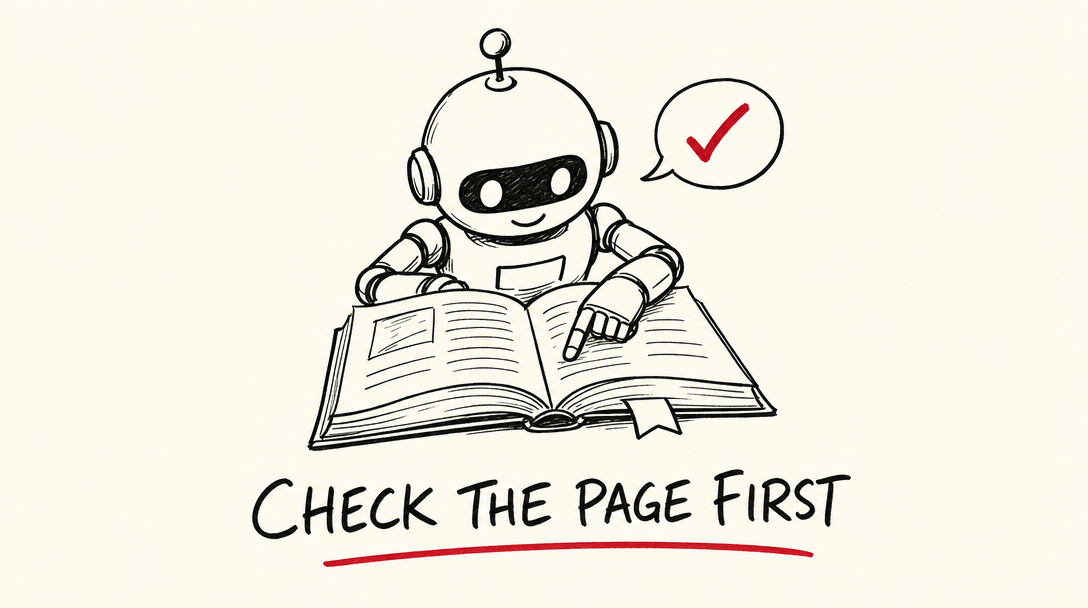
That is the whole trick. A normal language model answers from memory, the way a student writes an exam from whatever is in their head. RAG hands that same student an open book and says: check the relevant page before you write. The model still does the writing. It has just stopped guessing about facts it was never taught.
Answers from memory
Confident, and sometimes making it up.
Checks your documents first
Grounded in your own material.
The reason this matters for a business is boring but important. The model knows a lot about the world in general and almost nothing about you. It has never read your standard operating procedures, your past client threads, your pricing sheet, or the note your best closer wrote about handling a stalled lead. Those live in your documents, not in the model. RAG is the wiring that lets the model reach into your documents at the moment it answers, instead of inventing something that merely sounds right.
I want to be honest about why I know this. I earned IBM’s certificate in RAG and agentic AI. Not because a certificate proves anything, but because I wanted to understand the plumbing under the buzzword before I built anything on top of it. Most of what gets sold as AI magic is this plumbing, dressed up. Once you see it, the mystery drains out, and you get better at spotting where it earns its keep versus where someone is charging you for a feature you do not need.
Where RAG actually helps
It helps when the answer lives in documents the model has never seen, and those documents change often.
A support inbox that has to answer from your own policy pages. A lead-response setup that needs to know what this specific company already promised this specific prospect. An internal assistant pulling from a knowledge base your team updates every week. In all of these, the value is not that the AI is smart.
It is that the AI is finally looking at your material instead of the internet's average guess.
From what I saw in my agency years, this is exactly the gap that quietly costs money. The lead that sits for three hours. The follow-up that references the wrong offer because whoever sent it did not have the account history in front of them. A model with good retrieval does not fix your process by itself. It removes the excuse that the information was too scattered to act on fast.
The same logic holds beyond agencies. Most businesses already run on a private library: directives, SOPs, finance records, contracts, client histories. That library is exactly the material RAG was built for. It is large, specific to you, and it moves. Ask an ops question and the answer comes from your own playbook, not a generic best practice. Ask about a deal and the model quotes your terms, not an internet average. For finance and contracts, keep the human check on answers that matter. The stakes are exactly why grounding beats guessing there.
Where RAG is overkill
Now the part most people skip. RAG is often overkill.
If the facts you need fit in a paragraph, you do not need a retrieval system. You need to paste that paragraph into the prompt. I have watched people reach for a full vector database to answer questions that a single well-written page of instructions would have handled. If your knowledge is small, stable, and general, the model probably already knows it, or you can tell it once. Retrieval earns its place when your knowledge is large, specific to you, and moving. Below that line, it is machinery you will maintain for no real gain.
What RAG will not fix
Here is the honest bit.
RAG does not make the model reason better. It gives the model better source material to reason from, and that is a different thing. Feed it messy, contradictory, out-of-date documents and you get confident answers built on messy, contradictory, out-of-date documents. The polish stays. The reliability does not.
It also does not guarantee the model tells the truth. Good retrieval lowers the odds of a made-up answer, because the real information is sitting right there. But the model can still misread what it pulled, or blend two documents into something that was in neither. RAG reduces the guessing. It does not remove the need for a human to check the answers that matter.
And it is not a substitute for putting your own house in order. A retrieval system is only ever as good as what it retrieves. If your documents are a mess, the fastest upgrade is not fancier AI. It is spending an afternoon cleaning up the source material, so that when the model reaches in, it grabs the right thing. That work is unglamorous, and it is usually where the real gains hide.
RAG is not intelligence. It is the AI checking your book before it speaks.
So is RAG for you?
The test is narrow and practical. Do you have a body of your own information that a good answer depends on, and does that information keep changing?
If yes, retrieval is probably worth the build. If your questions can be answered from general knowledge or a page of notes, save yourself the machinery.
That is the plain truth under a term that gets thrown around like a spell. RAG is not intelligence. It is the AI checking your book before it speaks. Point it at the questions where your own documents hold the answer, keep those documents clean, and check the ones that matter. That is most of the value, and almost none of the hype.