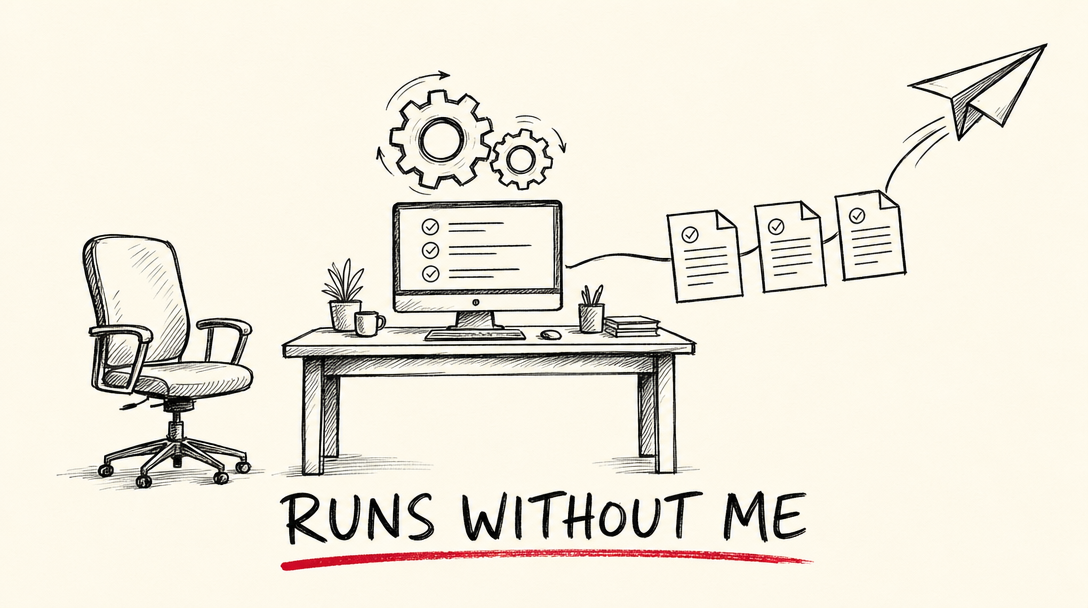
“I build AI systems that run without me. Then I share what works.” That is a house rule I set for myself. It reads like a productivity boast. It isn’t one. I set it after most of a working life spent doing the exact opposite.
For most of that working life I built things that only ran when I was in the room. Custom projects. Client work. Every deliverable was bespoke, every account needed hand-holding, and the day I stopped, the income stopped with me. I collected promotions and delivered work that ran on television and in games, and none of it changed the basic math: the work only existed while I was at the desk.
Here is the part almost nobody in this industry says out loud. If the work only happens while you are in the room, you do not own a business. You own a job with better branding.
The point of building it is so that my presence is optional.
So when I say a system runs without me, I mean it literally. The work happens whether I am at my desk, on a flight, or on the floor with my son. Not “mostly.” Not “until something breaks.”
Why I care is not a business reason.
I became a father after years of trying to have him. When he was born I stopped working almost completely for seven months, because I was not going to miss that. That was only possible because time, not money, is the real constraint in my life. Money you can earn back. The seven months, you cannot. Every system I build now is a way of buying more of those months back.
I have been using these tools longer than most people realize. GPT-3 for client writing before ChatGPT existed. Midjourney while it was still in beta. On the automation side I started with Zapier, moved to Make when it got serious, then to n8n when I needed real control, and now I live in Claude Code most days. None of that was hobby experimenting. It was production work, and it taught me the difference between a tool that saves you an afternoon and a system that removes you from a job entirely.
I would rather try and fail than never try.
Years before any of that I ran two faceless YouTube channels for about two years. Faceless was the whole idea. The channel had to run without me on camera, without me narrating, without me in the frame at all. I hired a team for hand-drawn animation, brought in professional voice actors, and built a pipeline that turned a script into a finished video with my face nowhere near it.
The machine worked. The economics did not. The niche paid almost nothing per view, so costs ran past revenue, and after a full year I closed it.
I would rather try and fail than never try. But I walked away knowing exactly how to build a content system that runs without its founder, because I had already built one.
That is the pattern under everything I do now.
- Find the part of the work that repeats.
- Hand it to a machine that never tires, never forgets the follow-up, never sleeps in your timezone.
- Keep for yourself only the part that needs a human. The judgment. The read on a person.
Find the part that repeats. Hand it to a machine that does not get tired, does not forget the follow-up, and does not need me awake in a different timezone. Keep for myself only the part that actually needs a human: the judgment, and the read on a person.
The agency software I built years ago worked the same way: leads handled and followed up without anyone having to remember. I built it that way because of what I saw in those years. Most agencies still run on human power for the parts that break quietest: the lead that sits for three hours, the follow-up nobody sent.
That is a system problem, and system problems are the ones I know how to remove a person from.
The second half of that line matters to me as much as the first. Building a thing that runs without you is a lonely win if you keep the method to yourself. So I write it down. Not the polished version where everything worked, but the actual version, including the faceless channels that ran perfectly and still lost money. If one piece of what I learned saves you a year I already spent, that is the whole point of putting it here.
I am not doing this to disappear from my own work. I am doing it so the hours I spend are the ones only I can spend. Building something I care about. And being home, present and unhurried, for the person I built all of it for.