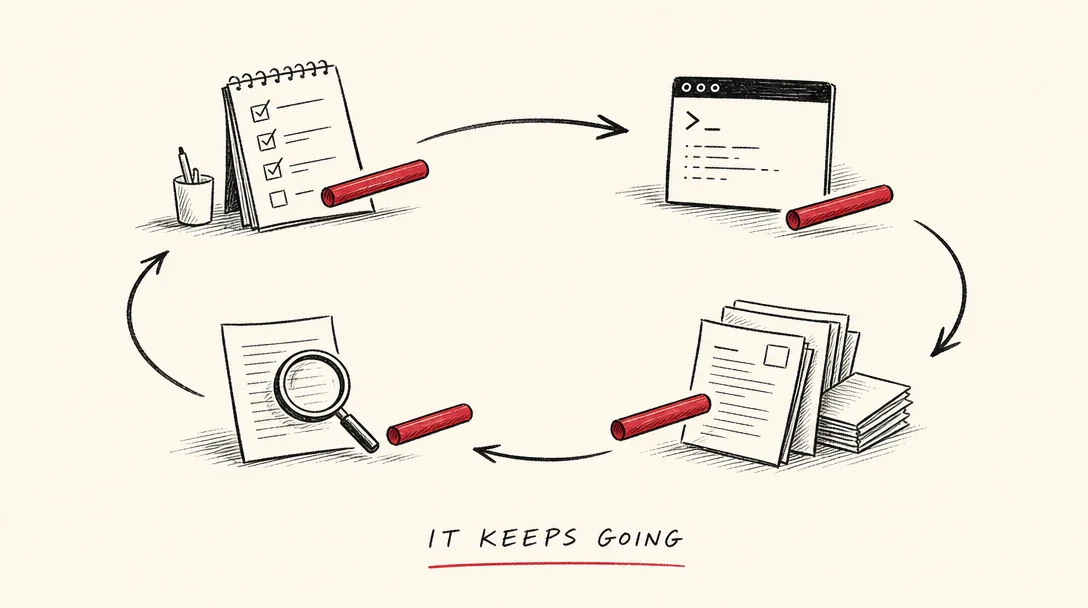
An AI agent is a model that keeps working after you stop typing.
That is the honest definition under a word that gets used for everything right now.
A chatbot answers you once and waits. You ask, it replies, and the conversation is over until you speak again. An agent is different in one specific way: it is given a goal, a set of tools, and permission to take more than one step. It does something, looks at what happened, and decides what to do next. Then it does that again, and again, until the job is done or it hits a wall.
That loop is the whole invention. Everything else is packaging.
Act
Use a tool: search, read, write, send.
Check
Look at what actually happened.
Decide
Pick the next step, or stop.
Repeat
Until done, or until it needs you.
Why does that matter to a business? Because most valuable work is not one answer. It is a sequence. Find the new lead, look up what we already know about them, draft the reply, check the calendar, book the slot, log it. A chatbot can help you with any single step if you stand there and feed it. An agent can walk the sequence on its own, which means the work happens at 2 a.m., on a Sunday, while you are at dinner. The value is not intelligence. It is the fact that nobody had to be watching.
I should say where my view comes from. I have spent years building automation for real businesses, starting with Zapier, then Make, then n8n, and these days mostly systems built around Claude. I also went and earned IBM’s certificate in RAG and agentic AI, because I wanted to understand the plumbing before I trusted it with anything real. If you want the retrieval half of that story in plain English, I wrote it up in RAG for non-engineers. This piece is the other half.
Agent, automation, or chatbot?
Here is the practical way to tell the three apart, because most of what you actually need is not an agent.
An automation follows a fixed script. When a form is submitted, send this email, add this row, notify this channel. Same steps every time, no decisions in between. If your process never branches, this is the right tool, and it is cheaper, faster, and far more predictable than anything with a model inside it.
A chatbot is a model you talk to. It is superb at drafting, explaining, and answering, and it does nothing when you leave the room.
An agent sits in the middle: the steps are not fixed, so something has to make judgment calls between them. Which of these three replies fits this specific customer? Is this lead worth a follow-up today or next week? Does this invoice look wrong enough to flag a human? When the sequence needs decisions, not just steps, that is agent territory.
If the steps never change, you do not need an agent. You need an automation, and it will not surprise you.
From my agency years, the pattern I keep seeing is businesses reaching for the exciting tool instead of the right one. I have watched people put a model in charge of a process that had exactly one path through it. All they added was cost and a new way to fail. The reverse mistake is quieter: a human sitting in the middle of a decision-heavy sequence, copying context between tabs, being the glue. That person is doing agent work by hand, and it is exactly the work that quietly eats a week.
The part nobody puts in the demo
Now the honest bit. The loop that makes agents useful is also what makes them risky.
A chatbot’s mistake is one bad answer, sitting in front of you, easy to ignore. An agent’s mistake compounds, because the next step is built on the last one. A wrong guess at step two becomes a confidently wrong email at step five. And since the whole point is that nobody is watching, nobody catches it in the moment.
This is why every serious agent system I have built or studied spends most of its design effort on something unglamorous: deciding what the agent is allowed to do alone, and what forces it to stop and ask. Reading data, drafting, sorting, summarizing: fine, let it run. Sending money, deleting things, making a promise to a customer in your name: it stops and a human clicks yes. The skill is not in making the loop clever. It is in drawing that line in the right place.
An agent is not a smarter chatbot. It is a junior hire with tools, and it deserves the same supervision you would give one.
That framing, a junior hire with tools, is the most useful one I know. You would not give a new hire your bank password on day one. You would give them a narrow job, watch their first twenty attempts, and widen the leash as they earn it. Agents deserve exactly that treatment, and the businesses getting real value from them are the ones treating trust as something the system earns, not something the demo promised.
So do you need one?
The test is the same narrow, practical kind I used for RAG.
Look at the work you wish would happen without you. Write down the steps. If the steps are the same every time, buy or build an automation and be done. If a single step just needs words or answers, a chatbot covers it. But if the sequence needs judgment between steps, and it is currently running on a human being the glue, that is where an agent earns its keep.
Start it on something where a mistake is cheap. Let it draft, sort, and prepare while a human still presses send. Widen the leash only when the record shows it deserves it.
That is the plain truth under the buzzword. An agent is a model in a loop with tools and a goal, working while nobody watches. That is genuinely new, and genuinely useful, and it is still just an employee you have not finished training. Treat it like one.